ESTABLISHED 2010 - Beyond The Campfire was created to encourage readers to explore the great outdoors and to observe it close up. Get out and take a hike, go fishing or canoeing, or simply stretch out on a blanket under a summer sky...and take your camera along. We'll talk about combining outdoor activities with photography. We'll look at everything from improving your understanding of the basics of photography to more advanced techniques including things like how to see photographically and capturing the light. We'll explore the night sky, location shoots, using off camera speedlights along with nature and landscape. Grab your camera...strap on your hiking boots...and join me. I think you will enjoy the adventure.

Saturday, March 18, 2023

The Meadowlark and the Prairie Pond

The tallgrass prairie, once covering over 400,000 square miles, as a continuous ecosystem was virtually destroyed in a few short years. By 1900, over 95% of it was lost to agricultural development and urban sprawl. However, a few remnants still exist. One of my favorite locations to visit and photograph is Oklahoma's Tallgrass Prairie Preserve, just north of Pawhuska, Oklahoma. It's almost 40,000 acres of original tallgrass prairie is the largest tract of protected and unbroken tallgrass prairie left out of the few scattered remnants of what once stretched from southern Canada through the central portion of America all the way to the Texas gulf coast. 


It is one of the few places where horizon to horizon vista's of tallgrass prairie, unmarred by man made structures can still be observed. I've made a good number of visits to this remarkable landscape over the years and have yet discovered all of what it has to offer. It's been a few years, Spring of 2019, since my last visit; circumstances has prevented my return, but I from time to time revisit this amazing landscape through memories and the thousands of photographs I've taken there.

Recently, I browsed through some of the images and spent some time examining a single photograph; The Meadowlark. It perhaps captures one of the most enduring elements of the prairie and that would be the myriad of wildlife that can be found there. Here is the story of how this image was captured.

On my last visit to the preserve a few years ago, my intent was to spend upwards to a week camping in a nearby campground, and spending the days driving through and hiking into and across this landscape. As luck would have it, I was greeted with thunderstorms, heavy rain, lightning, and tornado warnings which lasted for most of my time there. As a result I pulled out a day or so early having been thoroughly water logged. Although the rough weather curtailed a lot of my plans, it did not prevent me from exploring and photographing. 

One of the more productive locations I explored was a small prairie pond located just a few dozen yards or so from the gravel road that winds its way through the preserve. I suppose it was about mid-day on my second or third day, there was a lull in the rain and I decided to spend some time just sitting near that pond. With my tripod and 50-500mm lens I found a somewhat dry place to sit and just waited for whatever might appear.

Over the next few hours a good number of migratory birds including Long Billed Dowizers, one American Avocet, several kinds of Sandpipers, ordinary black birds including a Redwing Blackbird, and Killdeers which were fun to watch with their broken wing antics trying to lure me away from their nesting sight. There were a few Common Terns buzzing around performing aerial acrobatics, and a few Meadowlarks that spent most of their time riding the tops of the tallgrass stems that surrounded the pond.

One particular Meadowlark landed about twenty five yards or so from where I sat. He was just out of range really where I was unable to capture any kind of close up shots, but his striking yellow and black coloration stood out against the green of the prairie grasses. It just so happened that he perched on a stem that made him just about eye level with me. Slowly, I scooted across the damp ground lifting my tripod carefully forward. I closed the distance a few yards when the Meadowlark spooked and flittered a few yards further away, stopping again clinging to the tops of a tall stem of prairie grass.

I stopped moving, positioned my camera and zoomed out to 500mm and focused on the smallish figure of the bird. Between me and the bird and also behind the bird were thick layers of tall grasses which became blurred as a result of the exposure values. The overcast skies generated a soft filtered light across the landscape, and I snapped several images before the Meadowlark decided to move on.

I really did not know what I had until several days later when I returned home and began to rummage through the thousands of photos. This one stood out as it represented nature at its best and an environmental portrait of a beautiful prairie bird.

I'll never forget that trip. It was unique to say the least with the stormy weather. In hindsight, it was the stormy weather that helped to present another unique side to the Tallgrass Prairie; Nature in its raw form always creates the most demanding of changes, and change is what a photographer is compelled to capture.


Wednesday, March 15, 2023

The "Brick" - Argus C3


 My dad passed away a few years ago. He was one of those unsung guys who could be counted as among " The Greatest Generation", having fought during WWII on the Island of Leyte, Philippines as part of General MacArthur's return. He also fought in the bloodiest battle of the Pacific War on the Island of Okinawa. He was attached to the 96th Division, 321st Combat Engineers. It's an odd story really how he became assigned to an engineering outfit. You see he was not very mechanical; barely knew which end of a hammer to hold, but he did have a year of college behind him and while in college he took a photography course. Somehow or another, the Army in all of their infinite wisdom thought his photography skills might be useful in an engineering outfit, so that is where he ended up. He did take a lot of photographs during that time, not one was ever used by the combat engineers. His camera of choice was the venerable Argus C3, otherwise known as "The Brick".

Of the meager possessions he owned at the time of his passing, the only one I truly wanted was his Argus C3. It was not the actual camera he carried across the Pacific, but another one his good friend from his college and army days found and bought for him many years later. It is indeed a brick and earned that nickname because of its reliability and ruggedness, not to mention it is about the size and weight of a brick.

The C3 was manufactured by the International Research Corporation, Ann Arbor, Michigan starting in 1939. They changed their name to Argus in 1944, about the time my grandfather purchased it for him just before my dad shipped out. A little research revealed it cost about $70.00 which was a substantial sum back then for a camera. Being my grandfather probably did not earn more than about $150.00 per month at the time, it was a real sacrificial outlay of funds for him to buy it.

My dad during his WWII
Army days - circa 1944
Taken with his Argus C3

He took a good number of Kodachrome color slides, most of which have been lost over the years, and he also took a lot of black and white photographs of his time overseas. I have a precious few of them in my collection. Many of them were damaged while overseas by fungus and mildew because of the humid and often damp and hot conditions.

Not sure what ever happened to his original one, but the substitute camera his friend purchased for him was probably manufactured in 1955 according to the serial number.

A while back I loaded that old camera with a roll of 35mm black and white film and shot a roll through it. The focus, being a rangefinder, was a bit off, as the focusing knob was really hard to turn, but it was fun to give it a try.

Heavy Equipment Operations
Taken with the old Argus C3
circa 1944/1945

I suppose as I have grown older, nostalgic reflections have become more important to me. Possessing that old camera and the history surrounding that particular model as it relates to my dad, well, it's just hard to place a price on such a thing. I break it out ever so often just to feel it in my hands, and yes it does weigh almost as much as a real brick. We've all been spoiled today with the technology of digital cameras and computers. Back then, you really had to know what you were doing to obtain a decent photo. 

I don't know, maybe I will give it a try again someday, if I can find a place that will develop the film. Just holding on to it and gazing through the fuzzy viewfinder is almost like looking through a time machine. Sometimes I wish I could travel back in time in cognito and visit my dad during those war years and observe first hand just how important that old camera may have been. Even though the one I do have is not the same camera he carried, it's close enough and serves as a connection between two era's. Photography, it seems, has indeed connected me to my dad's legacy.


Wednesday, March 8, 2023

Me and Walter Mitty: A Great Deal In Common

 Have you ever met Walter Mitty? He's a friend of mine, well, not in any kind of real sense, but he and I share a great deal in common. Walter Mitty, if you are not familiar with him, is a fictional cartoon character, created many years ago by James Thurber around 1939. Walter was this guy who liked to daydream and in his daydreams became a swashbuckling, bigger than life heroic character. The reality of his life fell a great deal short of that, as he was actually quite timid and mundane. Yet, his alter ego transported him into a world of adventure far removed from the boring and simplistic world in which he lived. 

There are times I still feel like Walter Mitty. Growing up I lived so many daydreams I sort of got lost in them at times. Daydreams like becoming an astronaut, or a great athlete were common, but my favorite was dreaming about being a fighter pilot who ruled the skies zooming here and there challenging the bad guys in duels of bravery. Needless to say, none of those things ever came true. I suppose there were many reasons for that, but truth was, my dreams were bigger than my ability to turn them into reality, at least that is the excuse I fall back on when those melancholy thoughts about how, windows of opportunity have closed, begin to resurface. 

Recently, I re-read Chuck Yeager's biography called "Yeager". Chuck, of course, was the guy who first broke the Sound Barrier flying the research airplane the X-1 way back in 1947. He was just a country boy who grew up in the hills and hollers of West Virginia who became a war hero ace fighter pilot who turned test pilot. He went on to become one of the most celebrated pilots of all time. I guess what captivates me about Chuck is how he jumped on the opportunity when it presented itself. He said about himself, "I was at the right place at the right age in the right time of history..." And, so he was. He was not highly educated but had an uncanny understanding of mechanical things and a natural instinct when it came to flying. It was those instincts that pulled him out of some pretty hairy situations. He also said, "The secret to my success was that I always managed to live to fly another day..."

Chuck was no Walter Mitty, he was who Walter wanted to be but never was. I've read about a lot of bigger than life characters, but Chuck Yeager stands apart from all the rest, and I believe America needs more Chuck Yeager's now more than ever.

Yeager also wrote another book called 'Press On'. It's a follow up to his biography but concentrates more on his hunting, fishing and outdoor related adventures. Mixed in with all of those stories are tales of his flying exploits. It mostly takes place after he retired from the Air Force and what impressed me about it was how he just kept on going trading one kind of adventure for another. I would have expected nothing less from the guy.

By now you may be wondering where I'm going with this story. I guess it is to encourage anyone to keep on going in spite of your age or circumstance. It's okay to have dreams and its okay not to have all of them come true. Even though Walter Mitty an I have a lot in common, there are differences. You see even though I never fulfilled my wildest of daydream, I did manage to have some adventures along the way. Those four years I spent in the U.S. Coast Guard performing search and rescue work, for example, were without a doubt the closest I ever came to a swashbuckling adventure. I still claim those years were the defining moment of my young adult life and who I am today is still influenced by what I experienced way back then. I more than likely would never have pursued the outdoor adventures I've managed to live in recent times had I not served those few years so long ago. I have hiked and backpacked parts of the Rocky Mountains, hiked long stretches of rustic beaches, canoed crystal clear waters and spent time simply laying on the creek bank soaking in the moments. I met and fell in love with the love of my life, Kris, who has been my life partner for over 41 years now. I've learned about how to capture the natural beauty of the world through photography, and pursued and finished a thirty year career as an IT specialist. And now, I am retired.

Oh, I still daydream from time to time and wonder...what if...had I challenged myself when I was younger to follow through with those daydreams. Even so, as I've grown older, I realize just how important those daydreams were, for they helped to mold, encourage, and lift up a young boys imagination, and self awareness enough to where his reality and Walter Mitty's deviated away from each other ever so slightly to where he and I live different lives, and I would not change any of it.


Thursday, March 2, 2023

Behind The Scenes: More Than Just a Photo

 I love all four seasons, it's just I love the fall season a little more than all the rest. There is something about the allure of fall. It is as though nature is providing one last splash of color and drama before the dormancy of winter sets in. I suppose that may be why I reserve a portion of the fall season to get out and explore not only photographically, but explore the inner self as well, by testing and challenging myself to step deeper, stride longer, and search with more depth for a more fulfilling moment alone with nature. 

In recent years and through various seasons, I have taken a bunch of photos most of which are ordinary captures of ordinary moments. However, a few stand apart for they tend to capture a moment in time captured within the realm of an extraordinary experience. This single fall scene photo taken in the backcountry of Mammoth Cave National Park is one such photo. On the surface it appears to be just another woodland photo highlighted by early season fall colors. Behind the scenes, it represents a favorite discovery where time and place blended with an unusual circumstance.

I was backpacking into the backcountry of the park early in October of 2022. My troublesome hip slowed me down as it has done before. Slowed, but not detoured, as I stumbled onto a old cemetery where a good number of old and weathered headstones stood. Dates on some of the headstones drifted back well into mid-1800's. Somehow along the way, I had missed a turnoff I needed, to head down to a campsite I had reserved for the first night. By this time I was tired and my hip hurt, so, I decided to setup camp off in the woods a few yards from the cemetery. The next morning I would continue on to my intended destination at a second campsite, my favorite, called The Bluffs.

All through the day, I kept hearing the laughter of a small child. Faint as it was, it was clear enough to catch my attention and I kept looking up trying to determine from where it was coming. I never did. I kept faintly hearing it at random with no discernable pattern or direction. Also, all through the afternoon, I struggled to capture any kind of meaningful photos. I just wasn't feeling it.

Eventually, I meandered back to the cemetery and took a closer look at the headstones. To my dismay, there were a good number of young children buried there having died long ago at very early ages ranging from as few as a couple of months to a few years old. As I was looking at the headstone of a young boy, I again heard the distant laughter of a child. Because it was windy that day, I figured it was just the wind creating an odd creaking sound through the tree branches. But the laughter continued randomly off and on up until just after sundown.


The next day I broke camp and hiked the short distance to The Bluffs. After setting up camp a second time, I spent a good part of the afternoon continuing to search for a meaningful photo...and ever so often, I would hear the faint sound of a child's laughter, only this time it seemed to be coming from in the direction of the cemetery, about a mile or so away in a straight line.

Late in the afternoon, I worked my way around the edge of the bluff and up the slope on the far end, about a third to half of a mile or so from the campsite. Across the canopy the trees were in their full fall colors, with some of the lesser vegetation still green. Nothing was jumping out at me photographically until I arched my way closer to the far end of the bluff and looked up. Standing there was this one dead tree, seemingly anchored along the edge of the bluff and reaching toward the sky. Surrounding it stood a myriad of other trees and foliages. I framed the shot and snapped the image. Oddly enough, when I think back on the moment, after taking that photo, I cannot recall ever hearing that laughter sound again.

Every photo has a story that surrounds it, within and through it. This one was unique in that it was captured during an unusual, somewhat haunting span of time. Since then, I have wondered what it was I heard on trip. Was it the wind...or was it something that simply cannot be explained. It matters not, I just know there is more to a photo than just the image. Each one is connected to a story, and serves as reminders of moments from times past, much like the headstones that serve to remind us of the lost stories of those children buried in that old cemetery. Since that day, I have wondered about their stories, but I suppose I will never solve the mystery from where the haunting laughter of a child came.


Other Links

https://www.blogger.com/blog/post/edit/2887971606745077770/640721479560565135


Video Link

https://youtu.be/DL6reEx6qqg

Monday, February 27, 2023

A Look Back: Old Stores


The near ancient timbered floor creaked in time with the deeper reverberation created from the clomp of each step. That clomping sound seemed to flow outward, but not return, only to be absorbed by the brick and mortar and wooden framing within the walls. Old buildings tend to sound the same, feel the same with their often tired yet not yet broken spirit. They have a feel about them newer buildings will most likely never have. It is a feeling of time and place, of history and story. Their sounds, their feel, their aroma, all provide a manner of time travel where one is instantly removed from the here and now and transported back to earlier days. They were days which held their own hopes and dreams as different as they might have been from today, yet just as real, just as important, maybe dare I say, more so than today.

Wister circa 1915

A few years ago, Kris and I made a stopover visit to my old hometown in Oklahoma. While there, we entered into an old building on the south end of town across the old railroad tracks. The building was an antique shop at the time of our visit. I remembered this old building from my youth. As soon as I walked up the weathered stairs onto the front porch area and entered, I was transported back to my youth growing up in southeastern Oklahoma in the small, Mayberry-like town of Wister. Even then in the mid-1950’s Wister was an old town and all the buildings were made of weathered and faded red brick, on the sides of which were painted the remnants of advertisements for Big Chief writing tablets or Bull Durham tobacco. My grandparents for many years ran a “Dry Goods” store known as “The Dixie Store”, a two story, long squared off building.


Made of brick like all the others it stood alone just on the south side of the railroad tracks. Inside were wood and glass counters containing various sorts of small merchandise from that early 20th century era. The walls were adorned with lady’s calico dresses, men’s work overalls, boots, hats and other assorted necessities used by the blue-blooded working class of America. And, of course, there was the floor…the wooden floor which more than likely generated the same creaks and moans from foot steps that faded toward the back of the long rectangular structure.

Just down from “The Dixie Store” maybe a couple hundred yards stood the old mercantile store my Aunt Mae and her husband ran. Look closely at the photo on the right. In the distance you'll see a building partially hidden by another brick building. It has an overhang and a white front.

Mae was my grandfather’s sister, and she and her husband ran the quintessential grocery and general merchandise kind of store. I remember well as a young lad running up and down the front isle. The sound of the old wooden floor creaking and rumbling underfoot. I can even remember how certain boards would bend and give when weight was applied and of course, the aroma and ancient feel of the place. That old mercantile building had a look and feel all its own where old timers sat on the front porch in a set of rocking chairs wasting the day away.

“Slow down there boy…” they would say with half a laugh as I ran up the wooden steps to the heavy wood and glass front door. My grandmother would follow behind and they would nod their approval, “Morning Miss Ophie…”  “Morning Jack,” she would reply. Then with a brassy clunk as she pressed down on the door handle, we would go in. The door always seemed to stick and required a small jerk to pull it loose, then in a wide swing outward the old hinges would creak in protest as the door opened. On the day Kris and I visited, I reached for that same door handle. When I heard the brassy clunk and felt the door stick and wobble as I pulled it open, I felt like that 5 year old boy again taken back in time.

The world changed inside that old building. Outside in the summer drifted a torched, red-hot, dusty day with the cicadas screaming in the background. Inside it always felt cooler with the out of balanced overhead fans spinning from the high ceiling, creaking with each wobble. At least they stirred up the air and it felt cooler. It always seemed busy when we went inside. My first appointed mission was always to check behind the front counter where Aunt Mae always kept a small box of candy and bubble gum. I’d help myself at my grandmother’s chagrin. (When Kris and I stepped inside, those same old wobbly fans still stirred the air. My eye instantly drifted toward the counter on the right. I'd swear it was the same one from all those years before and I was tempted to take a peak just inside the back corner to see if there was any candy or bubble gum.)

“You ask before you take something now…” my grandmother would remind me as I opened the bubble gum I had extracted, then I’d pout and Aunt Mae would smile say it was okay…and off I’d go as happy as a three or four-year old boy ought to be. 

Those days were certainly simpler times having been tempered by more difficult days just a few years before. They were still connected by what many might consider outdated today…good manners, politeness, generosity, church on Sunday, a slowness of pace, a connection to family, a purpose in life other than just for self. Life certainly was slower, then, with far fewer distractions and a great deal more self-reliance. Sometimes I feel like the world has forgotten how to be like that. Well, as far as that goes, I suppose, so have I. All it takes is something as mundane as a creaking, worn out old door to shake me out of today’s hectic pace of life.

The Dixie store was long ago torn down, but it still stood when I was a young boy. All that is left now is just a concrete slab, and that may not still be there. The mercantile store Aunt Mae ran as far as I know, the building is still standing, it's been a few years since our return visit. Around 1950 or so, before I was born, my grandparents opened their own dry goods store on the other side of the tracks and did quite well until around 1967 or so. 

The new Dry Goods store - circa 1950

 During the 1960's there were two devastating floods   that all but destroyed the old nature of the town.   After the second one, my grandparents gave it up   and retired. 

 Whenever I enter an old building today and feel the   wooden floor, and breath in its ancient aroma, my   heart is instantly transport back to 1955 where the,   even then, old buildings simply by being there   created a wonderful Americana memory. Come to   think of it, 1955 felt more like 1905 in many ways. I   love old stores and I feel more like my old self after   having visited one.

Thursday, February 16, 2023

What Makes Great Light? - Shoot the Angles

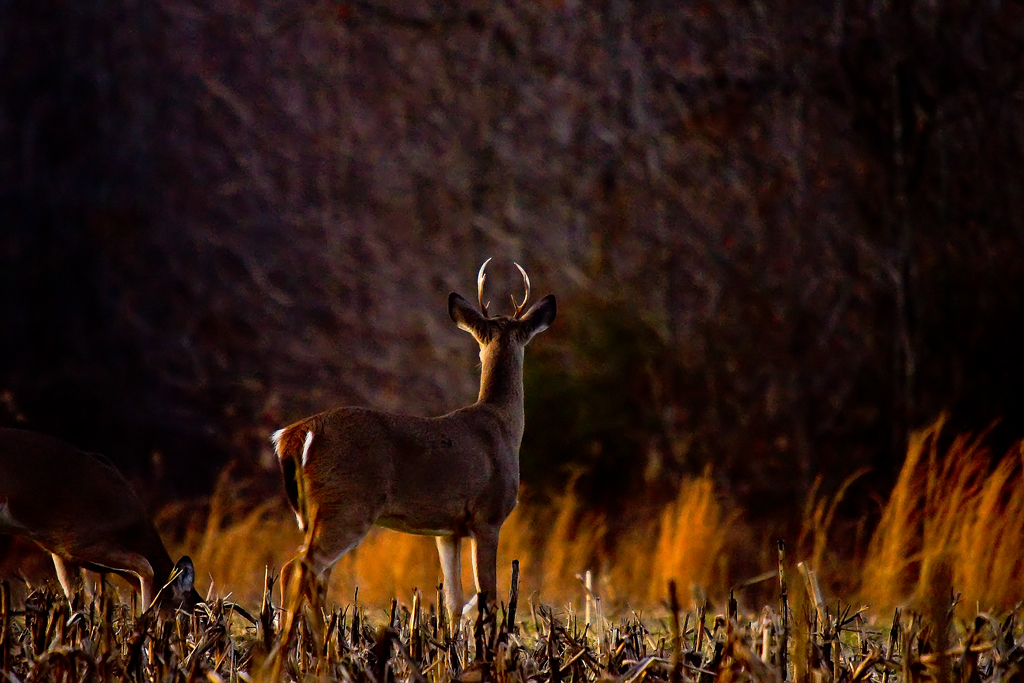
A line of thin clouds drifted a few degrees above the western horizon as the sun hovered between their opaque layers. This late afternoon light just before sundown cast a softly, shadowed, golden glow across the corn stubble field spread out in front of me. I hunkered behind a makeshift blind made of camouflaged burlap with my camera peeking over the top edge. Dressed in full camo myself I hoped to blend into the dark green backdrop a cluster of cedar trees provided. 

Across the field almost directly in line with the setting sun a few deer meandered here and there feeding on various shoots and probably spilled corn that still sat in the fields. One of them was a young little buck with what appeared to be a set of spike antlers, but turned out to be a set of six point antlers that protruded almost straight up. The closer he came, the more photos I snapped, none of which I felt were too exciting. Just as he approached the woods to my right, he stopped and the sun slipped below the thin veil of clouds throwing a warm glow across the field and into the woods. The little buck turned toward the woods and lifted his antlered head with an alert posture. The angle of the sun was such that only a few highlights accented across his form and the edge of the woods were bright enough to see clearly. I adjusted my exposure, purposely underexposing the image so just the highlights would become prominent. I snapped a couple of shots just before he again dropped his head and meandered into the woods.

Later that evening as I thumbed through the images from the days shoot, I wasn't impressed with all that many of them. Most were simply ordinary, until I came across this last series. With a closer look, the image stood apart from all the rest as the light created a unique look, a look that was enhanced by the angle and color of the light.

What makes good light when it applies to photography? The answer of course is rather subjective as it depends a great deal on what you attempting to photograph. However, when I dig into the question as it applies to how I approach photography, it becomes apparent that the angle of the light is a key ingredient. If you follow this blog very much at all, you will discover that many of the articles deal with light and how it by far is the most important element in nature or landscape photography. Subject matter is important for sure, but without extraordinary light, any natural subject will look, well...ordinary. 

When I browse through my favorite images, one thing stands out; virtually all of them were made using light coming from an angle. Angled light is what creates shadows and highlights. It also illuminates the subject in ways that direct light cannot. Angled light will often penetrate through the subject generating a luminosity that will often set the subject aglow. This after-glow gives life to the subject, especially things in nature like plants and clouds, and small critters. It brings out detail that would not be seen otherwise. It really does not matter what your subject is whether it be a person, a wild animal, a tree, a cloud, a single leaf, a flower, a drop of water...I could go on and on, angled light is the key to capturing mood and emotion.

 A single flower illuminated with front light may capture a technically good photograph of the flower suitable as an illustration, but will stir little or no emotion from the viewer...and being able to generate emotion is what sets apart ordinary photos, from extraordinary photos.

Even soft diffused light can be considered angled light because the light comes from all angles and thus illuminates the subject along with the background with a natural glow. This can also be used creatively within a wooded environment where only diffused light filters downward, through the canopy of trees to cast a muffled arrangement of light onto the subject.


Angled light is what I look for whenever I am in the field regardless of the conditions. Some days are better than others, sometimes it just does not happen, and other times you hit it just right.

 So, what makes great light? Well, it is light that falls outside the ordinary to enhance the moment, suspending your imagination beyond what is simply visible, to transport your imagination into the sublime where awe is not only inspired, but is potentially elevated into excellence. 

Sunday, February 5, 2023

Using Backgrounds to Complement, Enhance, and Support an Image

Any photograph that catches the eye will possess a multitude of combined characteristics to generate an emotional response. Most of us instinctively understand this and recognize the results whenever we see a good photograph. Things like focus, point of view, rule of thirds, subject, composition, color, and one very important element, light, among others, are some of the things a good photographer will look for and apply to his photography. However, it is easy to overlook one part of the equation; Background.

The background in a photograph can make or break the image. How we as photographers use this is as varied as there are numbers of photographers. From my perspective, whenever I frame an image, I subconsciously view the image from the foreground, across the middle, and through to the background. My eye rapidly advances across and around the frame to visualize what is there before I snap the shutter. It all happens in an instant and when it looks right, well the mind just knows it. Backgrounds then, for me, become the most powerful portion of an image next to light and just like bad light, a weak background can ruin a photo. They need to possess at least three qualities: It should Complement the subject, not compete with it, It should Enhance the overall impact of the photo, not detract from it, and it should Support the overall story you are wanting to portray. Let's take a look at each of these qualities starting with Complement.


A background should never compete with the subject. In the photo above, the simple green background complements the single flower. It was created by using a long focal length about 300mm, and a relatively large aperture probably f/5.6, plus the background was far enough away to allow for it to fall well outside the depth of field inherent in the exposure values. There is nothing here to compete with the subject. By compete I mean for it to be so out of place, it confuses or distorts what the subject is suppose to be. Things like powerline's are big ones. I see this all the time where there is a reasonably attractive photo with a series of black powerline's crossing overhead. 


Sometimes things like useless clutter that has no bearing on what the photo is suppose to be about can become a distraction. Many times clutter can be caused by using the wrong lense, or the wrong aperture settings which can cause distant objects to  remain in focus and thus compete with the subject. Many time this can be remedied by a simple change of perspective or angle. It is the photographers duty to recognize those things and choose a background angle that complements the subject. Also beneficial is to understand the use of Depth of Field. Defining depth of field, simply put, is that portion of an image which remains in focus while objects outside of the focal range becomes blurry. Things like what aperture is used, focal length of the lense, and the distance to the background come into play. Generally speaking, the larger the aperture the narrower the depth of field. Factor in focal length, and distance to the background, and distance from the camera...well, there are a good number of factors that affect depth of field, but using it effectively will strengthen how you build backgrounds that complement your subject.

 Complement simply means to separate and lift the subject away from distracting elements. Using a long lense, 200, 300, 500mm, and a large aperture , f/3.5, f/4.0, f/5.6, to blur out the background is one common technique to accomplish this. The use of soft, complementary colors is another technique. The background should be there just enough to know there is something there to identify a location or a moment or event. The angle and color or temperature of the light are powerful tools to apply as well. Also, a dark or light background will often serve to isolate the subject depending on the setup.


Not So Good

A background should also be able to Enhance the subject. To enhance means to make the subject stronger than it might be otherwise if it was against a mediocre background in so-so light. The image of this Cormorant is a good example of a not so good background in harsh light. There is not much appeal to this image...it's a snapshot taken in bad light with an uninteresting background taken from a bad angle. The image below of Sandhill Cranes is a much better example of how background and light work together to generate a wildlife image with much greater appeal. Wildlife photography is a entirely different animal because environment is as important as the subject. Capturing both effectively can be a challenge.


That leads into how Backgrounds should Support the subject. It matters not what the subject is. The background has to support the subject. For wildlife, think environment, for still life think in terms of effective use of lights and darks and color and how the background should impact of the image. For nature or landscape, Background is critical. Take a look at the Damselfly image below. Notice how the use of color and a soft background supports, enhances, and complements the subject.

There is just enough detail in the background to identify it as lush creekside foliage without it becoming a distraction. Also the first black and white image at the top effectively uses soft detail. Notice how the background sort of blends away into the fog leaving the subject standing apart from it.

Sometimes, the background actually becomes the subject. This can be tricky, but all the elements still apply. The image below of the reflections across this backwater slew is an example of how the background actually is the subject, yet it complements the subject story by the flavor of the moment. It enhances the subject with effective use of light and shadow, and it supports the essence of the story by blending all of the elements into a single story, a single moment of light.


Effectively using backgrounds will help to generate strong, story-telling, images. By applying a few simple techniques and training your eye to visualize how the background will complement, enhance, and/or support your image, what you create begins to express images with greater impact displaying more emotions and feelings as opposed to simple snapshot qualities. Recognizing those potential moments of light comes with experience. Applying that knowledge comes with practise both visual and mechanical.


Friday, January 27, 2023

Looking for Complementary Colors in Nature Photography - Visualize the Potential

 The other day I was watching one of those Create programs that featured a landscape painter. In this particular episode, the painter was in Venice and spoke at length about some of the old masters whose paintings effectively used what is called Complementary Colors. 

The concept of Complementary Colors is rather simple and involves two colors that fall on opposite ends of a color scale. Yellow and purple, Red and Green, are two common ones but the combinations range across the entire spectrum of colors and they do not necessarily require them to be directly opposite of each other, just within the color range being used, like shades of yellow and blue, or shades of orange and green.

After watching this informative program, I began to wonder how this concept applies to photography. As I browsed through a few recent photos I started to notice a common thread between many of them. It was obvious that complementary colors were a major part of the appeal to the images. I did not realize it at the time the photos were taken, but my eye naturally seemed to navigate toward the appealing nature of this concept.

Digging deeper into the phenomena, more and more images began to materialize with the prevailing theme of complementary colors. Some were bold and bright, others more subtle. For some, one major color dominated with only a hint of its opposite being there, while with others the distribution of the color was more evenly divided.In some instances a progressive layering of color flowed across the image shifting from one extreme to another, but fully encompassing the complementary elements.  In some cases, there were subtle variation like deep browns taking their place within the color realm of red while its opposite complementary color varied in various shades of green and pale yellow. 

It became apparent that nature is filled with complimentary colors and our eyes are naturally drawn to those combinations. What this revelation accomplishes is to open your mindset boldly enough to generate a desire to actively seek out these kinds of combinations while photographing nature.

Many times when I am out attempting to capture a unique image, I find myself struggling to see the moment. When this happens, and it does happen a lot, I slow down and simply ask myself, "What is it I'm seeing that is catching my eye...what is drawing me to itself?" 

Before long, I begin to notice small subtle compositions and more often than not, there is an element of complementary color to it.

The Moon Rise photo taken at the National Corvette Museum is an example of very bold color variations that not so subtly adhere to the complementary color theme. Within it you see the bold, redish-orange glow and reflection of the SkyDome and even the moon's glow, which are set against the bluish, purple backdrop of a dusky sky.


Although this not a nature photograph per se, it is a strong example of how the natural blend of complementary colors projects a powerful influence on our ability to recognize and see such things within our world.

A more subtle use of complementary colors can be seen in the image of yellow blooms set against a shadowy, bluish backdrop. Taken around the perimeter of a pond on an overcast day, the soft color variation blends well to create a mystique that fully uses the influence complementary colors has on our senses. 
An even more subtle use of this influence can be found in the image of a Ring-Billed Gull backlit against the shadowy bluff in the background. The shadowy bluff provides the contrasting bluish purple tone, and the gull's natural buff and white tonal shades provides a soft yellowish glowing complement to the background shade.

 There is even a bluish gray tonal value across the length of the wings. The combinations are very subtle, but they do exist and offers an interesting blend of contrasty backlight.

Even the banner page on this blog is filled with eye popping complementary colors.

Complementary colors in nature are nature's attempt at creating beautiful combinations of light.

 Many times, as photographers we are naturally drawn toward those combinations, but just as many times we may not even realize why we are attracted to such lighting effects. When we consciously make an effort to recognize how powerful and even how subtle these combinations are, you may find yourself taking another step toward being able to visualize the potential even before you ever snap the photo.


Thursday, January 19, 2023

Behind the Scenes - How the Photo was Made: Canoe Sunrise on Shanty Hollow

 If I were to choose my top five photos, this one would certainly be included in that list; Canoe Sunrise on Shanty Hollow. The story behind how this photo was captured always takes me back to one of the most memorable moments lived while exploring one of my favorite places, Shanty Hollow.

Shanty Hollow is about a 120 acre lake situated in northern Warren County in Kentucky. Surrounded by woodland rustic hills, covered in cedar, pine, and hardwoods, it retains a northern boundary waters atmosphere. There are hiking trails and a 60 foot waterfall tucked into the apex of a rock-walled ravine. 

Considering how relatively small the area, it is perhaps the most scenic of locations I've ever photographed. Year round it possesses a charm and exotic flavor to it that many much larger and expansive locations lack.

The canoe sunrise photo was made during a year long project I was exploring back in 2010-2011. Back then I was shooting with my old, but venerable Sony A100 camera. By today's standards, it is obsolete, but some of the best photos I've ever made were taken using that camera...many of them using a basic 18-50mm kit lense, Canoe Sunrise being one of them. How it came about required a great deal of forethought and a willingness to rise very early.

Shanty Hollow is about a 45 minute drive from my home. To position myself in the best location required I have my canoe gear pre-loaded on my Jeep and camera gear ready to go. That morning, I arose several hours before daylight, made the drive, off loaded the canoe, loaded the camera gear, and paddled in the dark the half mile or so to the far end of the lake where it opened up into a wider expanse with an unobstructed view of the sun rising above the eastern side of the lake. 

Paddling a canoe across a lake in the dark is a surreal experience for there is no sensation of movement. Above, the sky cast a faint star-lit glow across the lake and I could just barely make out the shape of the hills on either side. The lake was perfectly calm, no wind, no breeze, no sound except for the slight swirl from the paddle as it propelled me forward. A few bats still dipped and darted across the lake searching for a last meal before retiring into their lairs. A few of them whizzed by so close I could hear their wings whooshing through the air.


I arrived at the far end of the lake and turned to the west and drifted toward the dam. Only a very slight glow outlined the eastern side. Some fog drifted across the water barely moving in the calm air. Before long, that distant glow grew stronger and I tried to take a quick photo, but the light was just to faint, so I simply waited and enjoyed the moment. As the ridgeline grew more distinct with the backlit glow, the fog began to rise almost straight up. One mass of fog hovered a few yards above the water across the far side and the sunrise glow began to illuminate it from within which outlined the ridge line by its warm glow and was reflected on the calm surface of the lake.


I needed the canoe to be perfectly still and pointed directly at the sunrise. Using the paddle I gently nudged the canoe into position and waited for the ripples to dissipate. With no breeze, it remained motionless. I raised the camera, adjusted the composition by aligning the bow of the canoe to be perfectly centered, and fired off a couple of quick shots. What I saw on the view screen was encouraging, and I spent the next hour or so shooting numerous photos of that magical morning. 


Later that morning I returned home and loaded the images. Only a small amount of tweaking was required, a little contrast, a little brightness, a point or two of saturation. The photo pretty much stood on its own merits and, as an image, it became one of my favorites. As an experience, well, that morning was second to none.


Tuesday, January 17, 2023

A Backpack, a Canoe, and a Jeep - On the Edge of Adventure


The sickening crack happened so fast I had no time to react. The sequence of events that followed became one of those memorable and quite frankly, potentially serious, backcountry drama's I've often read about, but never dreamed would happen to me...but it did.

I found myself at the bottom of a steep, snow covered ledge, groaning as I thought I had broken my ankle by the tumbling slide and sudden jolting stop at the bottom. A moment before I had been safely standing on the edge of ridge that extended across the steep terrain for a good ways through the steep wilderness country contemplating whether I should just backtrack and follow my steps through the snow back to the trail. I was good mile or more off the trail inside the Rawah Wilderness in northern Colorado, hoping to find a shortcut to a series of mountain lakes I wanted to hike into and spend a day or two fishing. That shortcut proved itself unfollowable. I was just about ready to turn around when, CRACK!  In an instant I was at the bottom of the ridge. Apparently, I was standing on a root or stick or something buried in the snow and the combined weight of me and the backpack proved to much for it and it gave way causing me to fall to the bottom. I landed on one foot and the pressure jolted my ankle so much, I really thought I had broken it. If so, I was in serious trouble.

As it turned out, I only sprained it. It hurt something fierce, but I had another potentially bigger problem. There was no way to climb back to the top of that ridge. Even after checking my inadequate topo map, I realized the ridge extended way to far and too deep into the wilderness to follow it until I might find a way back to the top. Doing so would only put me into deeper trouble.

I did try to climb back up, but there was no way as too much snow and ice covered the ridge face and it was too high and too steep. With my mind racing and my ankle hurting I began to recognize early elements of panic setting in, so I simply sat down and fix something to eat with a hot drink. My backpack weighed in somewhere around 35 pounds or so and I knew I had plenty of gear; sleeping bag, tent, food, enough to survive for several days if I needed to. The problem was, how do I get out of this situation. Before taking off helter skelter, I finished my warm meal and hot drink which served to calm me down and I began to think through the problem. Looking at the topo map I realized if I moved down the slope I would eventually, probably, cross the hiking trail. I wasn't sure where I was, actually I was sort of lost and I wasn't sure how far down it was to the trail or even if I would cross it, but I couldn't stay where I was and the day was coming to an end in a few hours.

I hobbled to my feet gingerly testing my now swollen ankle. It hurt but I could walk, so I made my way down the slope hoping I wasn't digging myself deeper into trouble. After what seemed like a very long ways, there it was...the trail. Instantly, I felt a great deal of relief and managed to hobble the several miles back to my old truck before dark.

That is only one in a series of outdoor adventures my backpack, my canoe, and my Jeep (along with other vehicles) and I managed to experience over the years. Certainly, it was one of the more adventurous of adventures, and yes, I did eventually make it up to the mountain lakes about a month or so later.

Over the years I've approached my outdoor adventures from a minimalist perspective keeping my gear and effort to the basics for the most part. It's helped me to refine skills and build self reliance and confidence. Those three elements, backpack, canoe, and Jeep, have become the symbols really of my attempts at adventure. Without them, there would be few if any stories I can tell and retell about those days. 


My canoe(s) has/have provided a means to explore areas of adventure I could never have attempted without them. I've witness amazing sunsets, incredible sunrises, been caught out in storms, pelted by sleet and snow, blown off the water, and caught the reflections of a starry night on the mirrored surface of a lake. I have run rapids I thought too big to take in an open canoe, and watched Bald Eagles soar across the heights of breathless ridges. I've experienced perfect weather, high winds, freezing rain and sleet, and rising waters all on one five day trip. Most of those things one tries to avoid, but I've grown to look forward to them as they provide the avenues along the edge of adventure where the most memorable rewards are discovered.

One of the most enjoyable kinds of moments is when I am able to paddle my canoe early of morning after a night or two camping, across a calm lake with fog drifting across the surface. There is a magical feel to those times,  only discovered while slowly and silently making way through the fog while paddling a canoe. Not enough of those moments over the years, but when they do occur, I lock them into the memory banks of my heart to be recalled when I need them most.

My Jeep has discovered over 300,000 miles and is, after some improvements, still discovering. It may very well out live me. With it, I've been transported through snow packed roads, up washed out backroads, across hundreds of miles of open country, and witnessed amazing adventures through its ability. It has served me well and has developed a personality all its own. It needs a new paint job, but the way it looks actually adds character to its charms. The driver's seat has patches applied, but that simply shows just how much it has been used. The old canoe rack on top, scarred with a few rusty spots, has transported not only my canoe, but other friends kayaks and canoes, lumber, odds and ends, and even an old couch. 

I find myself drawn to the edges of the outdoors along with the challenges and rewards offered there. Being fully retired now, I for the most part have the time to seek out such adventures in spite of limited resources. It's the memories I cherish most of all. Being able to share them with others, well that's what this channel is all about, Beyond the Campfire. Yet, it's mostly for me so I can relive the memories and document some of the defining moments of my life hopefully for family and friends someday when my days are over. I keep much of it locked inside my heart but choose to leave some of it behind through the adventures found with a backpack, canoe, and a Jeep.

Those three elements have provided a great deal of practical applications, but most of all, they have been a part of, and contributed to, amazing memories discovered on the Edge of Adventure.

Saturday, January 14, 2023

Beyond the Campfire 2022 Highlights

 Certainly experienced some fantastic adventures during 2022. Captured many photographs and video footages. Highlights include backpacking, canoe camping, wildlife, weather, scenery and landscapes. Here is a short three minute video covering some of this fantastic year of photography!