ESTABLISHED 2010 - Beyond The Campfire was created to encourage readers to explore the great outdoors and to observe it close up. Get out and take a hike, go fishing or canoeing, or simply stretch out on a blanket under a summer sky...and take your camera along. We'll talk about combining outdoor activities with photography. We'll look at everything from improving your understanding of the basics of photography to more advanced techniques including things like how to see photographically and capturing the light. We'll explore the night sky, location shoots, using off camera speedlights along with nature and landscape. Grab your camera...strap on your hiking boots...and join me. I think you will enjoy the adventure.

Wednesday, May 18, 2022

The Sailboat

 My dad was a photographer of sorts. During WWII he carried an old Argus C3 and chronicled his adventures as his unit fought their way across Leyte and then again across Okinawa. I spent many hours while growing up scanning through the stack of war photos he managed to keep through the years. Only a handful are still in my possession with others being held by another family member. Wish I still had them all. Some years later while he was a high school journalism teacher he had access to a 35mm film camera...not sure what kind it was...but using it from time to time he chronicled a very few moments of my life growing up. One of the most memorable was the day he took me and a few of my friends to a small nearby lake so we could sail the wooden sailboat models we made in shop class. I still remember that day. At the time I wasn't aware he was taking photos. I'm sure glad he did.

The year was 1964, and time has faded the names of those friends in my mind, but not so of other events.  At the time we lived in Delano, California, for just a year, but it was an eventful year...sort of a coming of age year you might say. Learned a lot in shop class that year, simple but important skills really...how to cut a straight edge, how to use a jack plain, wood gouge, drill, sander, varnish...all those skills every young man should have. Our project for that semester was to build a model sailboat. And when they were finished, we possessed a work of art...well...to me it was.

I'll never forget that day at the lake. Seems it was slightly overcast with a light breeze that caused the palm trees to sway. It was perfect to catch the sails of the boats to propel them across the narrow arm that was just wide enough to let the boats get up a good head of speed, but narrow and shallow enough so we could run to the other side or wade out into the water to coral them should they start to drift too far in the wrong direction. 

We tried to set up races between the four boats. Most of the time the boats just drifted off in whatever directions the breeze inclined to take them and so it was pretty much impossible to declare a winner. Actually, we all were winners that day as we were able to forget about the challenges of being almost or at best barely teenagers and just have fun sailing something we made with our own hands.

I was this skinny 12 year old with an era style crewcut. Just 12 years old, but having already experienced some of the most dramatic events in history. A few months before in November of 1963, when we lived in New Mexico, an assassin's bullet struck down President Kennedy in Dallas, then the assassin himself was struck down live on television. Young minds should not have to see such things, but we did, and those wavy black and white television images were imprinted deep within our memories. They were difficult events to absorb, even more difficult to forget and move on, but they were none the less a part of that generation's history, memories that will never be forgotten by those who witnessed it. 

When my dad snapped these few photographs at the lake, little did he realize that he was capturing a renewing of sorts. The kind of renewing only a young boy coming of age can experience. Thoughts of that terrible day a few months before were shoved aside exchanged for adventures and visions of sailing on the high seas, of dreaming of new possibilities and probably what should be instead of dwelling on something...well...something a young boy should not have to dwell on. There were no counselors in schools to talk to the students about what happened back then, at least I don't recall ever receiving any kind of counseling. That was left to parents and to the kids themselves to sort through such things. Even though several months removed, building those sailboats was a kind of default therapeutic counseling and probably the best kind too. Those few months after the President was killed, when we were shown how to construct those sailboats in shop class, well, it served to divert our young minds toward something that was far less encumbering and more positive.

On those occasions I rediscover these few photos, I see in the expressions of us boys, a joyful focus, one that took us away from a terrible past event to point us toward a stronger growth of character that only comes from something as simple as sailing a homemade boat across a small arm of water. 

When I bring these photo's close...for a few moments, I am taken back to once again become 12 years old, remembering what it was like to experience such a day. I still remember that sailboat for it helped me to move away from difficult memories and to develop an imaginative mindset towards amazing true life adventures.


Friday, May 13, 2022

When the Lighting is Tough - Take Two

 Sometimes nature plays games with us as far as the light goes. No one has of yet developed a camera that can take two different exposures at the same time to capture two extremely different levels of light. Oh, yeah, you could use graduated neutral density filters and such to even out exposures. Sometimes that works when the lighting is only a stop or so different across the top or bottom half of an image. But when the light range gets up there where the top half of the image is a great deal brighter than the bottom half, well, the best way to make the capture is to take two shots then blend them in postprocessing.

Here's an example of what I'm talking about. The top half of this photo required a rather strong exposure to prevent over exposing it as the sky was quite bright. However, the bottom half was in shadow with barely enough light to illuminate it. What I did was to take two photo's with the camera on a tripod, one exposure for the top half not caring what the bottom looked like, which was black in this case, then another photo exposing for the bottom half which washed out the top portion.

In post processing, I simply opened both images and overlaid the second image with the first one. Using the eraser tool toned down to something like 50% opacity, I erased the overexposed dark bottom half which exposed the layer underneath, then merged the two layers. A little tweaking of the overall image, and, well you see the results.

When the lighting is tough, well, take two!


Monday, April 11, 2022

I Want to Tell A Story

In the world of writing there are seven basic story archetypes:  

Overcoming

Rags To Riches

The Quest

Voyage

Comedy

Tragedy

Rebirth

Every successful written story will follow a format that uses one of these formulas. A photograph also tells a story, although, the visual photo story often is far more complex and more difficult to define and create because of the wide variety of visual opportunities. Factor in the photographers personal preferences and the numbers increase even more. But, not surprisingly, a visual story will often fit within one of the seven basic story archetypes. 


Discovering how to accomplish this comes with not only experience but a basic understanding of story telling techniques. If I could always define how this is done...well, I probably could write my own ticket as a photographer. As this has not happened yet speaks loudly, however, when I look back on some of my best photographs, I can often see how they begin to fit inside one of these story types. 
Interpretation of the visual signals is, of course, very subjective and open to the individuals personal experiences. Most of the time, visualizing the story within a photograph just happens, sort of subconsciously. You just know it and see it without really thinking about it. I suppose that is what separates a so-so photo from a good photo...and a good photo from a great photo. Images with powerful visual stories simply jump out at you like a slap in the face "wham!, demanding renewed and closer attention. A weak photo just sits there mumbling to itself and the viewer quickly loses interest and moves on.

Compositional techniques contribute to the overall impact, along with the use of color or Black and White, angles, lens selection, timing, and of course the big one, the effective use of light. Composition is what builds the structure of a photograph, Light is what builds the story. What narrates the story is the effective application of both. I'm going out on a limb here to take a chance, but I'd like to use a few of my favorite images and break them down to define what I perceive the story they have to tell.


Let's look at the image from above. I've used this image as an example on numerous occasions and for good reason; it's probably one of my top two or three favorite photo's of all time. Of the seven story archetypes, several could apply. Maybe The Quest might fit, or possibly Voyage, but when I really think about it, I believe Rebirth is probably the best fit. Certainly elements from all three apply, but simply from the visual story being told, Rebirth is by far the most logical fit simply because of the nature of the photo. Taken at first light on an October day, the first beam of light that illuminated the cluster of trees extending into the field, tells the story of a new day beginning. A single white faced cow standing in the highlighted area near the bottom left is facing the morning with stoic fortitude and the light fog drifting across and amongst the trees adds a element of mystery and uncertainty about the day. What is unique about this image is how darkness helps to define the light. Without the darkness, it's just another average photo of a Kentucky field. With it, the illuminated areas take on a greater importance and serves to pull the reader into the story.


Another one of my favorite photo's is this one taken on Shanty Hollow Lake just before sunrise. I do believe Voyage is the obvious choice of archetype although elements of The Quest can be seen. There is something compelling about this photo. Compositionally, it retains a powerful symmetry. The tops of the ridgeline are purposely cropped from view, yet allowed to flow as a reflection on the mirrored surface of the lake. Fog floating on silent currents of air drift low across the water and the soon to rise sun can just be identified by the reflective glow of clouds just above and behind the hidden horizon. The photo at once strikes a sense of adventure toward some unknown rendezvous, rekindling emotions from a distant past not unlike what Lewis and Clark must have felt during their Voyage of Discovery. Along with the adventure theme, there resides a layer of calmness, a serenity of purpose where the viewer hopefully becomes captured within the larger story that emanates from within their own dreams.

Black and white is a favorite format of mine as it removes the distraction of color and focuses almost entirely on story through composition, shape and form. This image of the gravel road leading to a farmhouse strikes at the heart of what story telling in a photograph is all about. The graphic use of leading lines and dramatic light draws the eye inward into the story. In this photo, I would interject another archetype theme: Coming Home. To me it is one of the great story lines of all time. Coming home and what it takes to get there. It could be tragic circumstances, it could be rebirth, it could be a voyage or a quest. The viewer gazing at this image might interject all of them based on their own experiences. The fence posts, the highlights across the tall grasses along the edge of the road, the farmhouse nestled amongst the trees, the dark texture of the overcast sky all contribute to the story. One can almost hear the crunching of the gravel underfoot as you walk down the road and feel the brisk nature of the wind as it shoves the clouds along. There is an element of anticipation, maybe even dread knowing just how close home is, yet it is somehow still far away. How long has it been? Continue? Turnaround? What to expect, only time will tell.

People convey a multitude of story telling opportunities within a photograph. Combine them with dramatic light and weather conditions, they will often provide some of the most compelling of visual stories. In the photo on the left, a homeless man strikes a reflective pose as he contemplates his situation. Rain had fallen, dark rolling clouds were boiling low across the sky, and street lights cast a reflective glare across the compound, all aiding the story of lost dreams, lost hopes. Taken from a lower perspective, the use a small aperture created the star-like reflective glow around the street lights. In a way, that starry glare casts a kind of hopeful atmosphere amongst the gloom of the situation. Sitting with a forward lean, he retains an element of contemplative defiance, a proudness of self where in spite of his circumstances, he knows he has value and is not yet beaten. This is a powerful image of the plight of a single person facing uncertain circumstances, yet someone who still clings to a deeper understanding of who he is and who he can become.

Often when I begin a walk with my camera, I look for a story to tell. Most of the time the story remains hidden but is almost always there, somewhere. As a photographer, I want to use my instincts and personal experiences to dig out and find that story, and use my skill as a visual artist to capture it in a compelling and truthful way. It's not easy and it takes a keen sense of purpose and drive to first discover it, flesh it out, then develop it into a simple form that actually makes sense. I say to myself, "I want to tell a story.." then ask myself one question, "Where is it?"


Thursday, February 17, 2022

BTC Bushcraft: Cedar Stool/Table - DIY Bow Saw - Camp Cooking Tongs - Sharpening Knife/Axe

 Cedar is a marvelously hardy wood and when a large cedar tree fell in the wooded area behind my place after a storm a few years ago it must have sat there for a good number of years before I paid much attention to it. It had fallen across the deer trail path blocking the way so one day I took my chain saw out there to clean up the path for easier walking. A few cuts later and I realized just how hardy that tree was. It's branches had kept the main trunk off the ground so it remained mostly dry and the years had seasoned it. Cedar is probably the most aromatic of all trees and this one still retained its distinctive woodsy aroma. For the past couple of years I have continued to cut small pieces ( and a few larger ones ) from the trunk. It seems none the worse for wear. A few of the larger pieces I cut into round slabs and used them as bushcraft projects making small campfire tables that can also double as a stool.


In this video you will see how I used ordinary tools to build these. I also used the collapsible DIY bow saw I recently made and you can see how it assembles and is used. I've made a couple of bushcraft spoons recently along with a spatula, but I wanted to make a set of camp cooking tongs. You'll see how I managed to do that in this video as well.


I've learned the hard way how dangerous a dull knife, or any cutting tool, can be. Sharpening a knife to a razors edge can be time consuming and there are differing ways to accomplish this. Seems everyone has their own tried and true, and some not so effective, methods to sharpen a knife. Through trial and error I've learned what works for me and in this video you will see how I manage this process.


Hope you enjoy this short bushcraft video. It was a lot of fun making it and doing all the crafty things in the process.


Tuesday, January 25, 2022

Beyond The Campfire Bushcraft - Building a Campfire Chair

 Even from an early age I've possessed a fascination with things rustic. Way back when I was in grammar school I read a true story about a man sometime in the late 1800's, who spent an extended time alone in the wilderness taking with him absolutely nothing...no clothes, no tools, no blankets, nothing. He made a bet with a friend saying he could survive for several months (I don't remember the exact length of time) with nothing. His friend thought he was crazy but went along with the bet and dropped him off on the edge of the deep woods. All he wore that day was a bathrobe which he promptly tossed back to his friend and trotted off into the woods. The story chronicled how he survived...which he did...and he met his friend at the same drop off point on the designated day months later, strong, healthy, and ready to collect on his bet. That story altered the course of a young boy's life, where the natural world suddenly became something big, exciting, and wonderful, a place to explore and to find adventure, and over the years I've spent countless hours canoeing, fishing, hiking, camping, exploring the wonders of the natural world,...all be it, fully clothed I might add.

In recent months I've embarked on several photographic projects, the most current being Adventure Photography - The Art of Being There, where I explored the natural world near my home and captured it on video and photographs.  It's still an ongoing project and you can watch the video's on this blog, however I've kicked off a new project where I use in the field skills to create and use rustic things from the natural world...Bushcraft, it's called...and I have a lot of ideas and excitement about this project. Although photography will be a part of this adventure, it is more about being there to enjoy what nature has to offer. 

The first project is making a Campfire Chair using a few simple and basic tools. It was a fun project. So please enjoy this video of the process I used to create this unique and useful campfire chair.


Sunday, January 23, 2022

The Making of A Black and White Photograph

(An article originally posted on the Sunny Sixteen Camera Club Media Page: https://sunnysixteencameraclub.blogspot.com/2022/01/the-making-of-black-and-white-photo.html)

What makes a good black and white photo? It's not such an easy question to answer because black and white photos encompass a wide variety of subtle and subjective characteristics. Personally I love black and white. Color has its place and can present a powerful mood generating image. However, black and white allows for the removal of the distraction of color to focus more on subject and story. It becomes a graphic representation of what is captured, not an exact reproduction, but something that at once captures the essence of the subject yet allows the creative instincts of the photographer to interpret the story.

Story. I could write 20 articles about the photographic story and still not cover all of it. Story is key in a black and white photograph. It represents what was important to the photographer at that precise moment. It connects what happened before, to the moment now, through to what will happen. It allows the viewer to understand what the image is about. This of course can apply to all forms of photography, but in black and white, story is a must and it should be clear and to the point. Story is told through the composition and the elements within the composition should be kept to a minimum and obtain just enough information to clearly identify the story. Too much clutter confuses the story. Its probably better to have too little than too much. A minimalist approach can often provide a wonderful story. The capture interpretation is up to the photographer and how he / she visualizes the finished image can make or break the image.

There are two examples illustrated here. The first one above is a classic black and white interpretation where bold light and contrast is used to good effect. The second one is much more subtle and softer, yet it retains all the same elements as the first one. 

Let's look at those elements. In black and white, contrast is a key component. One thing to keep in mind is that most black and white images will run the range of tonal values from almost completely black to almost completely white with varying degrees of gray tones across the story line. Although these two images are quite different in nature, they still contain a full range of tonal values.

Composition is, as with all photographs, very important. The same principles apply. Things like Rule of Thirds, Point of Interest, and Light all add to the flavor of the black and white image. Look at the top image. Notice how light is used here. Taken at dusk, there was just enough ambient light to capture some background detail without overpowering the image. The light from the candle lantern illuminates the snow that has gathered on top of the small table. Some additional off camera light brings out the detail in the end-woodgrain of the table, and the hatchet handle reflects some of the light provided by the candle lantern. All these things provide separation of the elements within the story. The hatchet provides an action-taken element. The snow identifies time of year. The table offers a rustic flavor. The overall scene tells the story of a winter campsite.

The second image, a mirror image created to represent a reflection, was taken during a morning of heavy fog which almost completely obscured the tree and its surrounding terrain. The exposure turned the background almost white, yet hinted that something was floating around through the subtle nature of the soft gray effect. It's a simple story with soft, subtle elements, yet a very pleasing capture of a moment in time.

So what kinds of subject matter translate well into black and white. Personally, I favor big sky images, especially panoramic big skies. When shot using a polarizer, the contrast of the sky and clouds can be quite dramatic. Care should be taken to retain texture in the clouds when setting up your exposure, and you should always include something of interest in the foreground. 


Another of my favorites are dark ominous clouds. These can be tricky to capture, but when captured as a panoramic, they are quite dramatic. 


Snow is another great subject for black and white, but it can be tricky to capture. Auto exposures will almost certainly turn a bright white snow gray. 


It's just the nature of how the camera's auto exposure is made which wants to move white to a middle tone 18% gray value. Usually, snow requires from +1 to +2 stops of exposure compensation, but this is very subjective and sometimes something less will also work. What to avoid is flat 18% gray or blown out no detail white. It can be tricky and the right combination is often a subtle blend of whites and grays.
Flat 18% Gray Snow

Overexposed Snow


Most of my black and white photos were converted from color images. 
Most of the ones I converted were taken specifically for that purpose. Although post processing is 

important when it comes to creating a finished photo, that subject is well outside the intent of this article. I will say I use Silver Effex for my black and white conversion process, but there are numerous Lightroom and PhotoShop black and white conversion software addon's available. Lightroom and PhotoShop alone will do a credible job of creating a black and white conversion.


What makes a good black and white photograph? Well, I've only touched the surface of it here. Hopefully, this will give you some idea of how to approach this amazing form of photography. Thinking in terms of black and white while photographing the world around you can open creative opportunities and contribute a great deal to your photographic enjoyment.


Tuesday, January 18, 2022

Coming Soon! ... Another New Series! - Beyond the Campfire Bushcraft

 The Adventure Photography Series has been an exciting and fun project...and I will continue to pursue adventure opportunities as the seasons progress. Coming this year, 2022, I will be starting another new series that may prove to be the most fun of all. Beyond the Campfire - Bushcraft

I will be getting back to my roots where I'll be spending time outdoors, camping, canoeing, fishing, and creating fun bushcraft type projects. Things like building a camp chair using only a small axe and some chord.  Making a portable rustic bow saw. Primitive camping with a canvas tarp leanpee. Starting a fire using flint and steel and char-cloth along with/or using a ferrocerium (ferro for short) stick and striker, and some good old fashion roughing it easy camp cooking...plus other bushcraft style projects.

We'll combine camping, canoeing, backpacking skills with photography and spend meaningful time outdoors capturing and experiencing nature at her best. That's what Beyond the Campfire was originally all about and starting this season we're heading back to the basics. So strap on your hiking boots and come along for the journey as we explore, photograph, and experience nature beyond the campfire.


Wednesday, January 12, 2022

Two Adventure Photography video's

 Shanty Hollow - Part 4 - Winter Woodlands

Snow in Kentucky can be a hit and miss opportunity. Most winters the south central part of the state gets only a token or two of snow days. Sometimes, we get more, and sometimes we actually get what I call a mini blizzard. The first week of January saw one of those mini blizzards wrap itself around Shanty Hollow and I loved it. So for part of one day, then a few days later, for the entire day, I was able to get out and track through this beautiful and enchanting location ... in the snow. (Additional Shanty Hollow videos listed below)


Ancient Migration: Photographing Sandhill Cranes

Sandhill cranes are one of the most amazing migratory birds. The largest migration route takes across the central plains and into Nebraska where several hundred thousand of this fascinating birds congregate. A smaller, yet still impressive migration occurs a bit further east where 30,000 to 40,000 Sandhills make a stop over near Seymour, Indiana which is but a few hours drive from my home. I've managed to make it up there a few time across the past few years and have captured a lot of video and still photo's from those outings. This video is a compilation of those efforts. Please enjoy "Ancient Migration: Photographing Sandhill Cranes".


Additional footage: Shanty Hollow Part 1


Shanty Hollow Part 2


Shanty Hollow Part 3


Saturday, December 4, 2021

Soaring Amongst the Stars: What an Unforgettable Night

 Daytime temperatures hovered around 70 degrees, unseasonable to say the least for the first of December, and the blanket of air that arched across the daytime sky was a piercing clear blue. But as the sun settled behind the western ridge, those temps began to drop and the blanket of blue became a crisp and clean ebony universe filled with more stars than I have ever seen, their unexpected brilliance and shimmering nature uplifted my spirits and as I gazed upward through the canopy of trees that arch over my campsite, I felt as though I was being drawn high to join them amongst their lofty domain.


This adventure photography series I've been pacing through the past few months has brought me into contact with some incredible moments. The idea behind the series is simply about "The Experience of Being There"... to encounter nature through the eyes and heart of a photographer's mind set. But, it is more than that. It's actually more about the experience than the photographs. The photographs only serve to document the moments and their impact falls well short of the emotional influence generated by placing yourself inside an uncommon outdoor situation.

That single night camping out under the stars became an iconic moment within the Adventure Photography realm. I backpacked once again into my favorite location within the backcountry of Mammoth Cave National Park...The Bluffs. My intent was to do less photography and more just camping and relaxing. But I knew the evening was soon to fall upon me and the forecast was for a dark, clear night. With that in mind, I set about finding locations around my campsite that would offer a good field of view through the trees for some time lapse sequence photography. 


As the evening fell, a thin remnant of clouds began to glow above the distant ridge and shortly after, the sky rapidly grew dark and the stars began to wink into life. The first points of light were the planets Venus and Jupiter, two very bright lights to the southwest that hovered just above the ridge on the other side of the deep ravine below where I was camping. Shortly after Jupiter and Venus came into view, Saturn blinked to life almost perfectly evenly position between the two others. The three of them created a 45 degree arch across the darkening sky. Before long, thousands of other stars came into view, some brighter, some pin points, some with a fuzzy glow around them, some white, some bluish, some yellow in hue. Their seemingly random placement across the sky appeared to have a planned artistic symmetry applied to their placement with in the canvas of the night.

The tall trees surrounding me extended their reach upwards as though somehow knowing they added to the majestic nature of this incredible starry night. The first time lapse took close to 2 hours to complete, 200 15 second exposures taken at 20 second intervals. A quick look revealed that my campfire had provided an extra element to the scene by its flickering flames illuminating nearby tree trunks. 


The next two sequences were shorter, 150 20 second exposures taken 25 seconds apart. It too revealed a remarkable song of light arching across the night sky with the canopy of trees providing a guiding arm to their movements.


By 10pm, the constellation Orion came into view rising above the ridgeline. It is perhaps my favorite of all the constellations as it is big, bold, and bright especially on a clean and clear night like this one. With the naked eye one can see the Orion Nebula glowing as the middle star of the hunters sword. My goodness, it was so bright and clean, the sight of it was an experience of profound dimensions. 


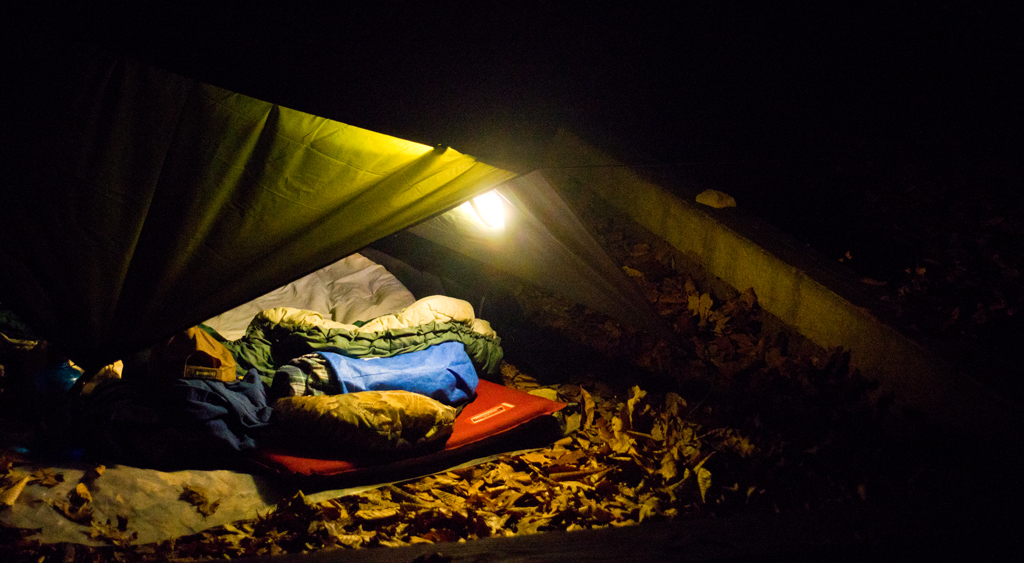
I set up my camera pointing toward this collection of stars...same exposure values...and fired off the sequence. As the intervalometer triggered each image one by one, I crawled into my sleeping bag under a simple tarp strung between two trees. 

Time was taken to make a journal entry as the thoughts were fresh on my mind...and I dozed off to the rhythmic clicking of the camera and the yelps and howls of a pack of coyotes.

It must have been because the camera stopped firing off that awakened me. I crawled back into the brisk night air and gazed upwards again. There are no words than can describe the sight. No moon was out, yet the stars were so bright, faint shadows were being cast by their light. The sky simply glowed with starlight, like a symphony, the musical tones of their performance was almost more than I could absorb. I no longer felt the coolness of the night air, warmed instead by a sight so indescribably beautiful, it all but brought a tear to my eyes.

I repositioned the camera, reset the intervalometer, and fired off another sequence. Reluctantly, I crawled back into my sleeping bag under the tarp. The warmth it provided calmed my emotions and I simply laid there listening to the clicking of the camera every 25 seconds and the occasional howl of coyotes was joined in chorus by several owls hooting through the night. I do believe they were also in awe of this special edition of the night sky.


I must have dozed off again briefly, but before long the camera stopped clicking as its sequence was complete. One more excursion into the night air...one more long view through the canopy of trees...one more long gaze at the most perfect night sky I've ever witnessed. The visions generated by that moment, haunted me throughout the evening as sleep became a rare event and only around 4AM did I finally doze off. When I awoke, daylight was upon me once again.

A much better story teller writer possibly could describe the feeling of the night in a way as to truly capture the essence of the moment. Although, I'm not so sure really anyone could fully describe the impact it had on me. I've spent may hours over the years photographing the night sky and from time to time encountered dark and brilliant nights. None compared to this one. It was truly an Unforgettable Night. One in which my spirit was lifted high into the realm of the stars, and I felt as though I soared amongst them.


Wednesday, December 1, 2021

A Simple Outing - Canoe on the Water - Phone Picture and Video - A Bald Eagle and Some Gulls

 About a 30 minute drive from my home thru small country towns, down winding country roads that flow through, around, and over the rolling hills of south central Kentucky, is Barren River Lake. It's a gem of a lake characterized by clear waters, rocky bluffs, thick woodlands, and scenery that can often be overlooked if care is not taken to avoid doing so. As a photographer, my eye is always searching for a special moment of light, and too often I too have been found guilty of overlooking this wonderful location.

Today I made a special attempt to remedy that verdict. I drove over to Brown's Ford with the idea of dropping my canoe into the water and working my way to the tail end of the lake, about 2 miles, where Barren River and Long Creek converge. The particular spot offers a wonderful peninsula that separates the two water systems. 

Where Barren River and Long Creek Converge - Taken Summer 2021 from the Long Creek side - Barren River is on the other side. This is the end of a long peninsula. Winter water levels would be 20+ feet lower than what is shown here.

I wanted to work my way up Barren River as far as I could manage using a trolling motor to do most of the heavy work, to search for a campsite along the river bank for a potential canoe camping, photography outing sometime in the future.

Taken summer 2021

The previous summer I managed to do some fishing in that area with some photography tossed in. Along with catching a few nice bass, I captured a couple of very nice images, one of a deer swimming across a gap between two small islands with misty fog hovering in the background, and another of reflections cast across a hidden inlet.

Taken summer 2021

Barren River Lake is maintained through the year by allowing the lake level to rise in summer and to drawn it down during the winter. On this outing, it was approaching its lowest winter pool level, about 20 feet or so lower than the summer level, and what was a wide expanse of flat water the previous summer was now a narrow band of shallow water with exposed rock and sandy banks. There was also a good current flowing at the boat ramp. My attempt at working my way to the confluence of Barren River and Long Creek was thwarted as the water levels were just too low to allow for a comfortable use of a trolling motor and the current was too strong to paddle against for that distance.

Instead I turned what was an ambitious outing into a simpler outing and took my time paddling around the boat ramp area working down to a long curving bluff to enjoy a short moment on the water. As I began to float that way, a Bald Eagle emerged from the tree line to my right and flew across the gap separating the long bluff from the bluff nearest to Browns Ford. He glided with a graceful soar, barely working his wings, the white of his head and tail standing out boldly against the gray background. Then, he pulled his massive wings back in a slow motion arch, almost stopping in mid air to land on a high limb overlooking the channel.

I had no camera this time except for my cell phone and it was still packed away, so I just drifted toward my Eagle friend and came to within about 20 yards of him before he launched himself into the air. I followed his white head and tail as he flew along the long, curving bluff, to finally drift out of sight some distance away. Not a single photo I made of this magnificent bird, but the memory of the moment will last me forever.

For the next hour or so, I simply paddled around, briefly talking to an elderly fellow fishing off the bank, and I managed with my phone to snap a photo or two of the scenic point anchoring the long bluff. I'm guessing the trees with the white trunks are Sycamore trees, and the tree with the reddish leaves are beech trees with their fall season remnant allotment of dried but not yet dropped leaves.

 As I made my way back to the boat ramp against the current, a couple hundred gulls circled around, squawking as they do, to eventually land on the other side of a sandy mound.

 I beached the canoe and made my way over to where they were and managed to take a few photo's using my phone along with a short video clip. They are graceful fliers after all.

The day afield came to an end shortly after my gull encounter. I loaded all my gear back into and on top of my Jeep, always a sad moment. As it turned out, the outing fell well short of what I was wanting to do, but in the end, seeing the Bald Eagle and watching the gulls was reward enough. Just being out and feeling the canoe under me again, well...it was a simple outing, but one well worth the effort.

Saturday, November 20, 2021

The "Art of Being There"

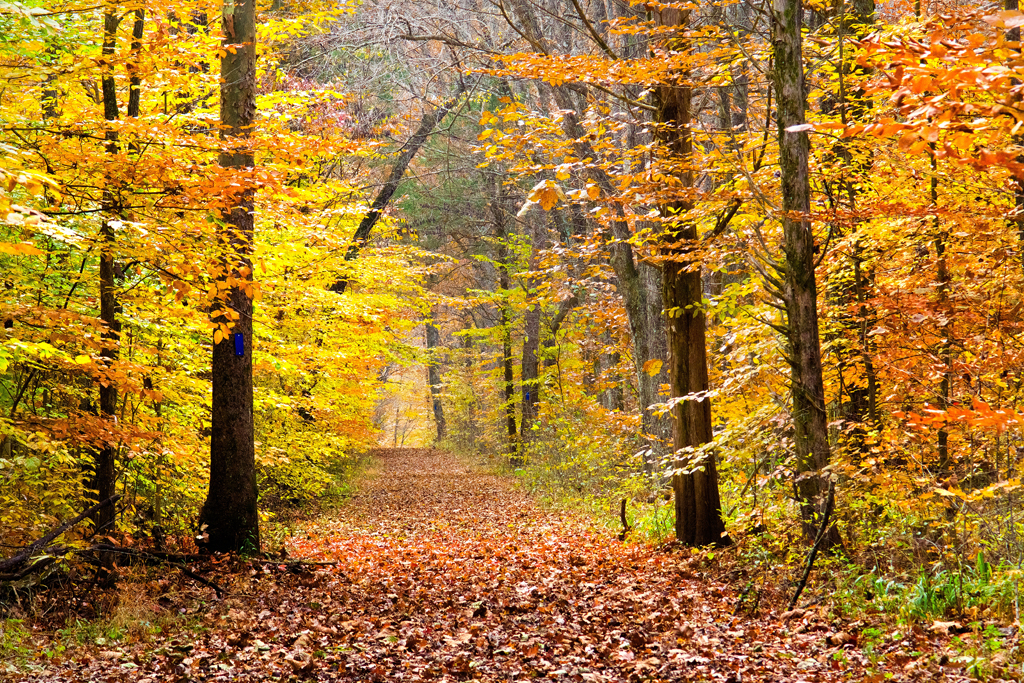
 The beauty of the fall season in Kentucky is breathtaking and hiking into the backcountry of Mammoth Cave National Park during this time of year can transport one into a visual canopy of color.

Capturing the feeling of this world requires more than simply physically walking down a trail with your camera in hand. It requires you to fully immerse yourself into and becoming a part of the surroundings. There is a kind of bonding one develops with nature when you allow yourself to let go of the everyday stresses of life and then receive the soothing comfort discovered here. It helps you to step outside the distractions of life, to be elevated above all the things that weigh us down emotionally, so you begin to see the hidden compositions drifting across the landscape.


I wish I could get that feeling every time I go out, but it is almost impossible to do so. There is an Art to it, the kind of art that is difficult to define. It is the Art of Being There where you allow yourself to become a part of the surroundings, where you feel the subtle sounds of the woodlands,

 hear the splash of light filtering through the trees, see the wind brush across your face, then inhale the aroma of the flotsam of the forest floor. 


When that happens, your camera becomes more than a tool…it becomes an extension of your emotions. The art of being there is what this Adventure Photography series is all about.

Yet it is more, for there will never be enough words to fully describe how it works because it is different for everyone. It's a feeling really, the kind that radiates deep from within yourself. It's more than simply recognizing that it can happen, it's experiencing it and living it all at once.

The Art of Being There as a photographer elevates those moments to a level well above what is ordinary...you are uplifted emotionally and everything becomes synchronized so much so, it all simply falls into place.


Wednesday, November 10, 2021

Backpacking Mammoth Cave National Park - Destination: "The Bluffs"

 Over the years I've done a favorable amount of backpacking, enough anyway to feel accomplished at the endeavor. I've done far more canoe camping but both are excellent outdoor activities and they share some common elements that tend to blend their requirements into similar techniques. I recently made a return visit to spend time backpacking into the backcountry of Mammoth Cave National Park. While it is but a few miles up the road from where I live, the location has remained a somewhat neglected outdoor resource for me. Even so, there is an abundance of above ground outdoor opportunity awaiting anyone desiring a near wilderness adventure.

This year I jumpstarted my Beyond the Campfire Adventure Photography video series with the intent to motivate myself into getting out to photograph and explore the great outdoors more while I still have the ability to do so. As I climb toward the big 70 in age, my physical ability to purposely stress myself beyond what is ordinary has started to diminish to some degree. 


Although I've stayed in pretty good shape for someone my age (lost 35 lbs, strength training at the gym, jumping rope, punching a heavy bag...and so on), my old body sometimes pushes back reminding me to slow down and take it easy for a little while. I've learned to listen to it in spite of the fact that my hearts desire tells me I'm still 25 years old.

My backpacking gear consists of mostly 25 years and older equipment...all venerable and functional...but, a bit on the heavy side. Today's modern, lightweight equipment was just a pipe dream back when I first started backpacking. Back then my budget allowed for only rudimentary and often heavy gear collected from the likes of the local Army Surplus Store, garage sales, and the local discount sporting goods store...a good portion of it was homemade make-do gear.

Similar to Mine

I use a 40-plus year old Coleman Peak One packer stove...probably one of the most dependable and useful pieces of gear I have. In all those years, it has never failed once. By today's standards, it is quite heavy, but it also includes the ability to fine tune the blue flame from a simmer to a fly me to the moon flaming torch. It will boil a pot of water in nothing flat, and a single tank of fuel will last for several days.

My old sleeping bag, also a Coleman Peak One, is also about 25 years old. It is filled with somewhere around 4 lbs of Quallofil fiber...where each strand when viewed thru a microscope contain 4 separate chambers...which gives it a temperature rating down to Zero degrees Fahrenheit. It's a bit bulky but has kept me warm on some very cold nights out in the boonies. A homemade flannel liner adds about 10 degrees to the temperature rating.

The newest piece of equipment I have is my self-inflating sleeping pad I purchased on a clearance sale about 15 years ago. One of the best investments I ever made.

I use 2 packer tents. One is somewhat larger and heavier than the other. On this trip I chose to use the bigger one because I wanted a little more elbow room for my camera gear. Made by Camp Trails it is a two man tent that actually fits one person and comes with a nice full cover rainfly which came in handy that night as a gentle rain fell pretty much all night.

The backpack I haul all of this gear around in is, again, about 25 years old. It is a JanSport Internal Frame large capacity pack. It has several outside pockets and various other straps and rings and things to attach whatever suits your style. It has been quite durable in spite of some abuse over the years.

Those are my main pieces of equipment along which I include various other assorted odds and ends to make up the 10 Essentials of Backpacking.

On this particular trip I included 2 cameras, 2 tripods, extra batteries, 2 extra lenses, and a fanny pack just for the camera stuff, because I wanted to shoot a lot of B-roll video footage and have enough flexibility to photograph the scenery as I saw fit. I normally would not have carried all of that extra weight, but in the long run I used all of it and the results were pretty good even if I say so myself.

The hike into the Bluffs area is pretty flat with some up and down dips and climbs until the last side trail that leads you to The Bluffs campground. There is about a 1/4 mile very steep drop down to the campsite and, consequently a 1/4 mile long very steep climb out. The climb out is much more difficult than the drop down especially when carrying a full pack.

Along the trail I encountered several muddy places but was easily able to skirt around them. You are pretty much walking through a cathedral canopy of trees, and during the fall, the colors are amazing. I made this trek the first couple days of November and although there were good splashes of color, the peak of the fall season had not arrived...(a week later it was in full swing).

A newer version 

There is a source of water near the campsite. A spring flows over the edge of the first bluff you encounter with enough flow to create a small pool of water at its base. It good clean water and it's enough to easily fill several water bottles but the water must be treated before drinking. T o do so, I use a pumper style PUR Hiker water purification system (now called Katadyn) that will filter out pretty much everything that could make you sick. I've never gotten even the slightest grumbling in the tummy after drinking the filtered water...and the taste is fresh and clean.
It was another one of those really good additions to my gear collection.

Photographing the trip involved a series of B-roll video clips where I set up a camera on a tripod then film myself walking a little ways down range...walking back to retrieve the camera...then continue on. I wanted to video sections that provided not only scenic value, but also captured a representation of what the trail was like. Doing this obviously took more time, but it was well worth the extra effort.

Photographing the area was at times a challenge because it was difficult to see through all the clutter and focus in on a good subject. Even so, there were numerous photo ops available with the bluffs and within the surrounding canopy of the woodlands. The lighting was tough as most of the first day it was bright and sunny with a cobalt blue sky. Pretty to hike in and look at, but difficult to photograph because of the harsh contrasts such conditions produce. That became the real photo challenge...how to capture the scenic value without capturing the harsh contrasts?


I was able to build a fire and spent a while after sundown sitting around the warmth of its flames. It was the first time all day I felt like I could relax. 

There is something magical about a campfire. I've built hundreds over the years and no two of them were the same, but each of them told a similar story. It's a story about why we need to sometimes put life on hold and travel into the wilderness to experience what it has to offer the soul. Sometimes Life gets in the way of Living. 


A campfire helps us to step away from the stresses of life, to experience the calling that resides within our hearts. Backpacking, in spite of the physical demands, pushes the Mute button on Life, so we can begin living a little.